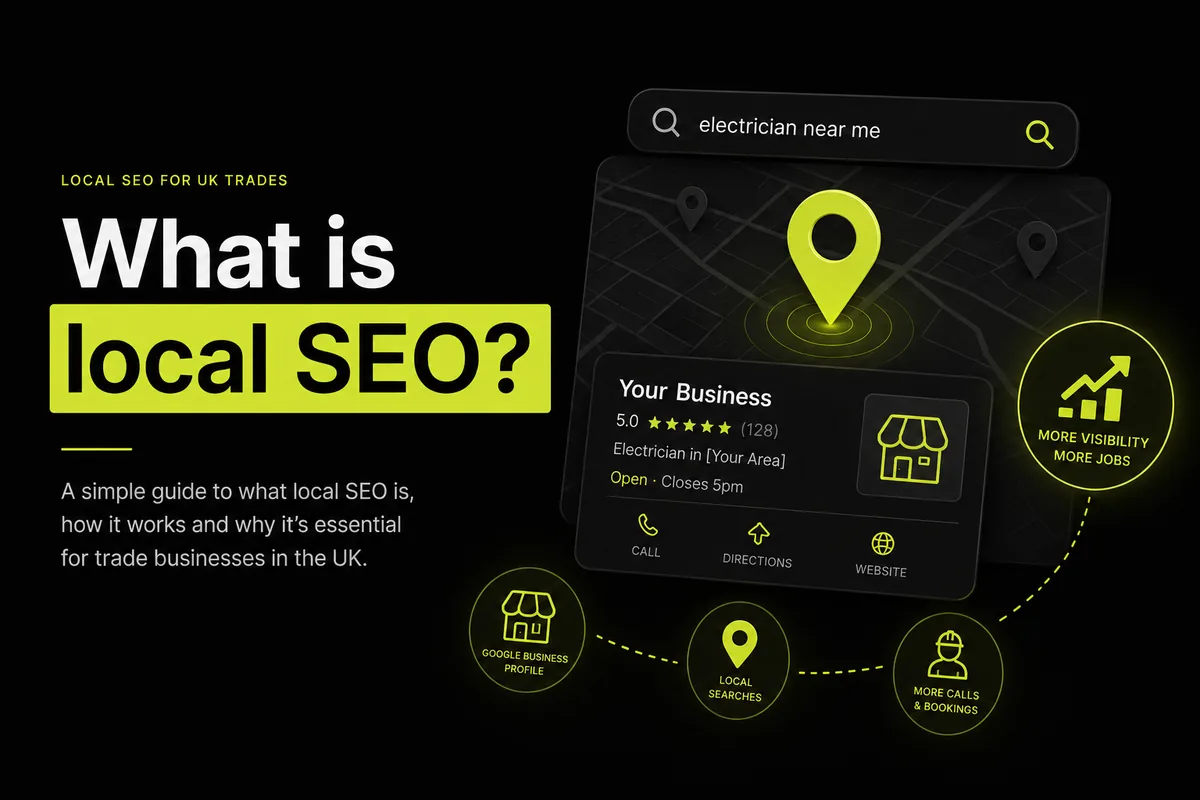
Local SEO is the practice of getting a business found in search results that are tied to a place. For a UK trades business that means appearing in the Google map pack, in Google Maps, and in ordinary web results when someone nearby searches for the work you do. It is driven mainly by your Google Business Profile, the service and area pages on your website, your reviews, and the consistency of your business details across the web.
On this page
- What is local SEO?
- How does Google decide local rankings?
- Where do local results actually appear?
- Why the Google Business Profile does the heavy lifting
- Which ranking factors matter most
- Local SEO vs traditional SEO
- Local SEO in AI search and LLM answers
- How to start: a first-90-days order of work
- Mistakes that cost trades businesses rankings
- How to measure it
- Questions people ask
What is local SEO?
Local SEO is search optimisation for queries where the searcher's location changes the answer. "Electrician near me", "emergency plumber Portsmouth" and "who fixes storm damage in Winchester" all have location baked in, either typed out or inferred from the device. Google answers those differently from a general query: it pulls from its index of local business listings as well as its index of web pages.
That distinction matters because it means you are optimising two assets at once. Your website is one. Your Google Business Profile, the free listing that produces the map pin and the business panel, is the other. Most trades businesses that struggle in local search are neglecting the second one.
How does Google decide local rankings?
Google states three factors for local results: relevance, distance and prominence.
- Relevance is how well your listing and site match what was searched. A profile categorised "Electrician" with services listed for EICRs and rewires is relevant to more electrical searches than a bare profile.
- Distance is how far you are from the searcher, or from the place named in the search. You cannot change your address, which is why service-area strategy and page-level targeting matter so much.
- Prominence is how well known and well regarded the business appears to be, drawn from reviews, mentions across the web, links, and normal web ranking signals.
Distance is fixed. Relevance and prominence are the two you can work on, and they are where a local SEO programme spends its time.
Where do local results actually appear?
A single search can show your business in several places at once, and they rank independently:
| Surface | What it is | What mainly drives it |
|---|---|---|
| Map pack | The block of three businesses with a map, usually near the top | Google Business Profile, proximity, reviews |
| Google Maps | Results inside the Maps app or tab | Same signals, with more results shown |
| Organic results | The standard blue links below | Your website's pages, content and links |
| AI Overviews | Generated summaries above results | Content Google can extract and attribute |
This is why "we rank number one" is an incomplete statement. You can hold the top organic position and be invisible in the map pack, which for most trades is the block that generates the phone calls.
Why the Google Business Profile does the heavy lifting
For a trades business, the Google Business Profile is usually the highest-leverage asset in local search, because it feeds the map pack directly. A profile that earns its place has the primary category set correctly, secondary categories for genuine additional services, accurate hours including any emergency availability, a defined service area, real photographs of real work, and services listed individually rather than lumped into a description.
Two details are worth calling out because they are commonly wrong. First, your primary category has more influence than any other single field, and choosing "Contractor" when "Electrician" exists will hold you back. Second, a service-area business that publishes a residential address is a different entity in Google's eyes from one that hides it, and the choice affects where you can appear.
Which ranking factors matter most
Ordered roughly by how much difference they make for a UK trades business:
- Google Business Profile completeness and category accuracy. The foundation. Nothing else compensates for getting this wrong.
- Review volume, recency and rate. A steady trickle of recent reviews outperforms a burst of old ones.
- On-site service and location pages. A real page about the work, in the place, written for someone deciding who to call.
- NAP consistency. Your name, address and phone number matching across directories, your site, and your profile.
- Local links and mentions. Suppliers, trade bodies, local press, sponsorships. Fewer and more relevant beats many and generic.
- Site fundamentals. Speed, mobile layout, and a phone number that is tappable without pinching.
Local SEO vs traditional SEO
| Local SEO | Traditional SEO | |
|---|---|---|
| Goal | Be found by people nearby who are ready to book | Be found by anyone searching the topic |
| Key asset | Google Business Profile plus site | Website only |
| Competition | Businesses in your patch | Anyone publishing on the subject |
| Trust signals | Reviews, citations, proximity | Links, authority, depth |
| Typical outcome | Calls and enquiries | Traffic and awareness |
Local SEO in AI search and LLM answers
People increasingly ask an assistant rather than scan a results page: "who is a good electrician in Fareham and are they available Saturday?" The systems answering that question, whether Google's AI Overviews or a chat assistant, are assembling an answer from sources they can read, parse and trust.
Practically, that rewards the same things good local SEO already rewarded, plus a few structural habits:
- Answer the question in the first two sentences of a section. Extractable answers get quoted. Preamble does not.
- Make each section stand alone. These systems retrieve passages, not whole pages, so a section that only makes sense after the previous one is a section that will not be used.
- State facts plainly and specifically. "We cover Fareham, Havant and Portsmouth, weekdays 7am to 6pm, with emergency callout" is usable. "We pride ourselves on outstanding service" is not.
- Use structured data. LocalBusiness and FAQPage markup give machines an unambiguous version of the facts a human reads off the page.
- Keep your details identical everywhere. Contradictory hours or phone numbers across sources make a business a risky thing to recommend.
The short version: content written to be understood, rather than written to hit a keyword density, is what survives the shift.
How to start: a first-90-days order of work
- Weeks 1 to 2. Claim and complete the Google Business Profile. Fix categories, services, hours, service area, and add real photographs.
- Weeks 2 to 4. Audit your name, address and phone number everywhere it appears and make it consistent. Correct the wrong entries.
- Weeks 4 to 8. Build or rewrite one page per core service and one per priority town, each with genuinely different content.
- Weeks 6 to 12. Set up a review request that happens automatically after a completed job, so it does not depend on remembering.
- Ongoing. Local links, Google posts, and answering the questions customers actually ask.
Mistakes that cost trades businesses rankings
- Publishing near-identical town pages. Ten pages differing only by place name are a doorway pattern, and Google treats them as one.
- Keyword-stuffing the business name in the profile. It breaches Google's guidelines and is a common cause of suspension.
- Letting reviews go unanswered, particularly the critical ones, which is where prospective customers look hardest.
- Chasing rankings instead of calls. Position for a keyword is a proxy. Booked work is the thing.
- Ignoring the phone experience. Ranking well and missing the call is an expensive way to do SEO.
How to measure it
Four numbers tell you most of what you need, and none of them is "keyword position":
- Calls and direction requests from the Google Business Profile performance report.
- Impressions and clicks by query in Google Search Console, filtered to your service towns.
- Enquiries by source, so you know which channel produced the job.
- Map pack visibility across your patch, checked from several points in the service area rather than from your own desk, since your own location skews what you see.
Questions people ask
Is local SEO worth it for a small trades business?
It is usually the highest-return channel available to a business that serves a fixed geographic area, because the audience is limited to people who can actually hire you and the intent is high. A search for "emergency electrician" is not research; it is someone about to call somebody.
Can I do local SEO myself?
Yes, for the foundations. Claiming and completing your Google Business Profile, fixing inconsistent details and asking for reviews are all within reach and account for a large share of the result. Ongoing content, technical work and link building are where most people run out of time rather than ability.
What is the difference between a Google Business Profile and a website?
The profile is a listing Google owns and displays; the website is an asset you own. The profile drives the map pack, the website drives organic results, and they feed each other. You need both, and the profile is usually the faster win.
Does local SEO still matter now that AI answers questions directly?
It matters more, and the work changes shape rather than disappearing. Assistants still have to name a business, and they draw on the same profile data, reviews and web content. What changes is that clear, specific, well-structured information gets used and vague marketing copy gets skipped.
How long before local SEO works?
Profile improvements can shift map pack visibility within weeks. Competitive organic terms usually take months. We cover the timeline in detail in how long local SEO takes for trades.
Want to know where you stand?
We audit your Google Business Profile, your site and the towns you want to win, then tell you what to fix first. No sales pitch, no contracts.